Wheel alignment control: Get a free quote • Fast response
Wheel alignment control
Is your car driving at an angle or does the steering wheel feel like it’s pulling to one side? Then it might be time for a wheel alignment check. A wheel alignment check ensures that your wheels are pointing in the right direction and gives you a safer and more comfortable driving experience.
Here you’ll find answers to all your wheel alignment questions and help you find the best auto repair shop near you.
Get a free quote for a wheel alignment check
Send us a short description of your wishes and needs, and we’ll help you find the best suited auto repair shop for your particular job.
Your contact information will only be used in connection with the request. Your personal data will not be disclosed to unauthorized persons.
What does a wheel alignment check cost?
The price of a wheel alignment check varies slightly from auto repair shop to auto repair shop, but is typically around NOK 1.500. Depending on where you are located and which auto repair shop you choose, prices usually range from NOK 1.000 to NOK 2.500. This usually includes a thorough check of the wheel angles and any adjustments needed. Some auto repair shops may have promotional offers from time to time.
Please note that there may be some additional costs if wear is detected on chassis components that need to be replaced to achieve the correct wheel alignment. Such wear can be caused by potholes and bumps in the road over time. The auto repair shop will then let you know about this and give you a price estimate before proceeding with the repair.
All in all, a wheel alignment check is a relatively inexpensive way to ensure the safety, tire wear and handling of your car. Most people only need to perform it every 2-3 years with normal driving.
What does a wheel alignment check consist of?
In a standard wheel alignment check, the auto repair shop will carefully check and measure the different angles of your wheels. The three main angles they look at are:
- Camber angle: The vertical tilt of the wheel when viewed from the front. Slightly negative camber, i.e. the wheel angled slightly inwards at the top, is often optimal.
- Caster angle: The angle of the steering axle. Affects directional stability.
- Toe angle: The position of the wheels seen from above, whether they point slightly in or out. A little “toe-in”, i.e. the wheels pointing slightly towards each other, is usually desirable.
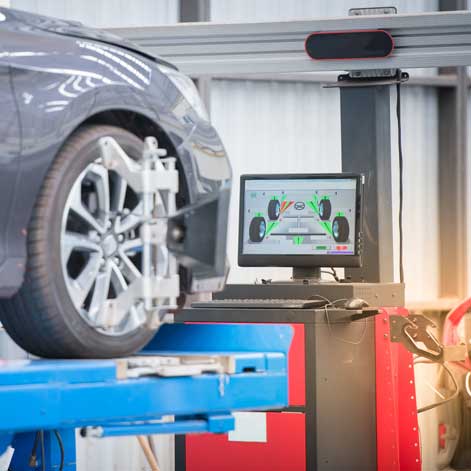
The auto repair shop uses specialized equipment to measure this accurately. If any angles are outside the ideal values, they will adjust this. This usually involves slightly loosening some bolts, moving some components, and tightening again in the new position.
They also check the general condition of the adjustment, such as wear in bolts, bushings and joints. If there is a lot of slack in some places, it can prevent correct adjustment. They will then recommend replacement of worn parts. Finally, they take the car for a short test drive to ensure that everything is working optimally. Then the car is ready for a few new years of stable and safe driving.
What affects the price of wheel alignment?
-
Hourly rate at the individual auto repair shop:
May vary based on location, expertise, equipment and general cost level. -
Car make and model:
Some cars may require special tools or have more complex settings that can make the job more time-consuming. -
Age and condition of the vehicle:
Older vehicles with a lot of wear and tear may need replacement of worn parts as well. This means more work and expense for the necessary parts. -
Scope of the check:
Some auto repair shops offer a simpler check, while others have a more comprehensive check with several measuring points. -
Need for recalibration of modern driver assistance systems:
Many newer vehicles require a calibration of the camera and radar after adjusting the wheel angle. This requires special diagnostic tools and takes extra time. -
Possible additional services:
Some auto repair shops include a wheel balancing or tire rotation at the same time. This may result in a higher total price, but is actually separate from the wheel alignment check itself.
How often should I have a wheel alignment check?
Many people recommend a wheel alignment check once a year, but for most cars, a wheel alignment check every 2-3 years is sufficient for normal use. However, some situations may require a wheel alignment check sooner:
- If you’ve hit a hard edge or driven into a large hole and suspect that something may be out of alignment.
- If you have replaced related parts such as steering joints, bushings, shock absorbers etc.
- If you experience the car pulling to one side while driving.
- If the tire wear is suddenly very uneven or looks abnormal.
- When you have passed 3 years or 30.000 km since your last inspection.
The most important thing is that you keep an eye on the recommended intervals, driving characteristics and tire wear. Then you’ll know when it’s time for a new wheel alignment check. Still unsure? Ask your auto repair shop for advice next time you’re in for a service.
How do you notice wheel misalignment?
There are some typical signs that may indicate that the wheel alignment of your car is off course:
- The car pulls to one side while driving on a flat road. You notice that you have to hold the steering wheel at a slight angle to stay on course.
- The steering wheel does not center properly after a turn. It tends to hang to one side even if you release it in the middle of a straight line.
- Uneven or rapid tire wear, typically the tread wears faster on the inside or outside of the tire.
- Poorer directional stability. The car feels wobbly or unstable, especially at higher speeds. It may be more sensitive to crosswinds or ruts in the road.
- Vibration in the steering wheel. Skewed wheel alignment can sometimes be felt as a grinding or vibration through the steering wheel while driving.
Some of these symptoms can also be caused by other issues, such as worn tires, suspension damage or wheel/rim misalignment.
If you start to notice any of this, a visit to the auto repair shop for a check is money well spent. A wheel alignment check is fairly inexpensive insurance for stable and safe driving. Catching misalignments in time also saves a lot on tire wear in the long run.
What happens if you drive with uneven wheel alignment?
Driving with an uneven wheel alignment over time can lead to a number of problems and expensive workshop costs:
- Reduced driving safety: The car can become difficult to control, especially in emergency situations. It may pull to the side or react slowly to the driver’s commands. This increases the risk of accidents.
- Rapid and uneven tire wear: Tires can be run over internally or externally, drastically reducing their lifespan. You’ll need to change tires much more often than normal.
- Increased fuel consumption: Skewed wheel alignment creates resistance and friction that counteracts the vehicle’s direction of motion. The engine has to work harder and uses more fuel for the same distance.
- Stress on the chassis: The entire chassis is subjected to unusual loads and forces. This can lead to faster wear and tear on key components such as suspension, joints, balls and bushings.
- Uncomfortable driving: You’ll notice that your car isn’t running smoothly and straight as it should. It can be tiring to drive, as you constantly have to compensate with small steering wheel corrections.
- Reduced tire grip: Incorrect wheel angles prevent optimal grip. This can result in poorer acceleration, weaker cornering grip and longer braking distances.
- Risk of failing the EU test: Incorrect wheel alignment can be enough to get you banned from driving until it’s rectified.
All in all, there are many good reasons to check your wheel alignment regularly and have it adjusted if necessary. It saves you a lot of money, stress and risk in the long run. And above all, it improves safety for yourself and everyone around you in traffic.
Can you correct the wheel alignment yourself?
The short answer is no. Wheel alignment should be corrected by experienced mechanics, as it requires special tools for accurate measurement of wheel angles. These are expensive and rarely found in the garage of the average man in the street. Even with the right tools, it takes experience to interpret the measurements and know how to adjust. Getting it wrong can quickly exacerbate problems. There’s no point in trying to save a few hundred bucks if you risk a driving ban or an accident.
Modern cars have complex configurations with many components that need to work together. It’s easy to overlook wear and tear or damage that should be dealt with by a professional. Many newer cars also need a subsequent calibration of electronic driver assistance systems after an alignment. This requires brand-specific diagnostic tools.
Correcting wheel alignment is definitely a job that should be left to professionals with the right tools, skills and experience.
How do I get a quote for wheel alignment?
To get a wheel alignment quote, you need to get in touch with an auto repair shop near you that offers this service. There can be many auto repair shops to choose from, depending on where in the country you live, and it can be difficult to know which one is best suited to the job. Auto repair shops may have different experience and expertise in performing wheel alignment checks on different cars.
We can save you time in the process. Through a collaboration with skilled repair shops across the country, we can easily put you in touch with a qualified auto repair shop in your area that has experience with wheel alignment checks.
Fill out the form on our site with some information and we’ll forward your enquiry to the auto repair shop that best suits you and your car. Our service is free and non-binding. The auto repair shop in question will contact you within a short time to make further arrangements.