Replacing the timing belt: Get a free quote • Fast response
Replacing the timing belt
Have you noticed that your car has an uneven ride, unusual noises from the engine or that the engine warning light is on? Then it may be time to replace the timing belt. The timing belt is one of the most important components in the engine, and if it breaks it can cause major damage.
Many people are unsure when the timing belt should be replaced and what it costs. Here are answers to the most important things you need to know about replacing the timing belt.
Get a free quote for replacing the timing belt
Send us a short description of your wishes and needs, and we’ll help you find the best suited auto repair shop for your particular job.
Your contact information will only be used in connection with the request. Your personal data will not be disclosed to unauthorized persons.
What is the function of the timing belt?
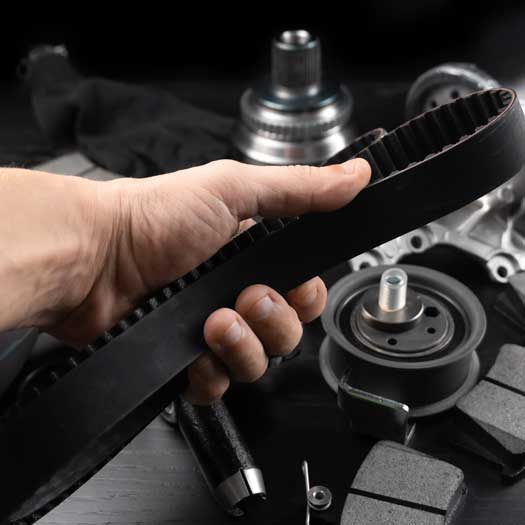
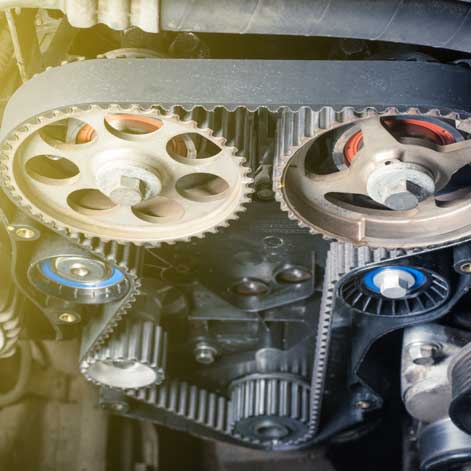
The timing belt looks like a thick rubber band with teeth on the inside and is an important part of the car engine. The main job of the timing belt is to make sure that other parts of the engine move at the right pace.
Think of it as a conductor in an orchestra. The timing belt ensures that the valves that let gasoline and exhaust fumes in and out of the engine open and close exactly when they should. Otherwise, the engine would be in chaos.
In addition, the timing belt helps power other parts such as the water pump that cools the engine and the alternator that charges the battery.
For the car to run smoothly, it’s important that the timing belt is tight and in good condition. If it becomes worn or breaks, the engine can be seriously damaged. That’s why you need to replace it before that happens.
What does it cost to replace the timing belt?
How much it costs to replace the timing belt depends very much on the type of car you have. Prices usually start from around NOK 5.000 but are usually somewhere between NOK 10.000-20.000. For some car models, replacing the timing belt is extra demanding, which can also lead to higher prices than this. It is also not uncommon to replace the water pump at the same time as the timing belt, since it is driven by the belt and has a similar service life. This would then increase the costs even further. The timing belt itself is not expensive and can actually cost as little as a couple of hundred NOK. It’s the actual job of replacing it that costs.
Many newer car models come with a timing chain instead of a timing belt. A timing chain is intended to last the lifetime of the car, but from time to time it will also be necessary to replace the timing chain. Replacing the timing chain is more expensive than replacing the timing belt because the job of replacing it is more extensive, and you should usually expect prices to start from around NOK 15.000. If the timing chain first shows signs that it should be replaced, you should do so as soon as possible. If it goes so far that the timing chain breaks, you risk having to replace the entire engine.
When should you replace the timing belt?
The interval for replacing the timing belt varies from car to car and is specified by the car manufacturer. Typically, the interval is somewhere between 60.000 and 160.000 km or every 5 to 10 years. For some cars, the first change is recommended already at 60.000 km, while others can go up to 240.000 km before change. Check the owner’s manual for your particular car to find the correct interval. Regardless of mileage, it may be a good idea to replace the timing belt if it is older than 5-7 years, as the rubber can become brittle and crack.
What affects the price of replacing the timing belt?
-
Car make and model:
Some cars have more complex engines where timing belt replacement is more time-consuming. -
The hourly rate of the auto repair shop:
Hourly rates vary between different auto repair shops and geographical areas. -
Parts availability:
For some car models, parts may be more difficult to obtain, increasing the price. -
Engine size:
Cars with larger engines tend to have wider timing belts, which cost more. -
Engine type:
Diesel engines and engines with overhead camshafts can have more complex timing belts that are more expensive to purchase and replace. -
Additional jobs:
When replacing the timing belt, you often need to replace the impeller, tensioner and water pump belt as well.
Some signs that the timing belt should be replaced:
- Visible wear on the belt
- Uneven engine running
- Noises from the engine
- Difficulty starting
- Warning lights that illuminate
- Leakage from the water pump
- Over 5 years since last replacement
Please note that there are not always clear signs before the timing belt breaks. Unexpected belt breaks can lead to engine failure and subsequent repairs that cost far more than just replacing the belt.
What happens if you don’t replace the timing belt?
The timing belt is a wear part that should be replaced at regular intervals. If the timing belt breaks while the engine is running, the pistons will hit the open valves and cause major damage. The crankshaft, camshaft, valves and other parts can easily be destroyed. In the worst case, the entire engine must be replaced.
Repair costs in the event of a broken belt can quickly reach NOK 50.000-100.000, and are far more expensive than a planned timing belt replacement. Such damage is rarely covered by warranties or insurance as it is considered the result of a lack of maintenance. Breaking the timing belt while driving will also lead to an abrupt and unexpected stop, which poses a safety risk in traffic. The consequences of not replacing the timing belt in time can be very serious, both in terms of safety and financially.
How can you check when the timing belt was last replaced?
- Check your car’s service booklet. All servicing and repairs must be stamped and documented with date and mileage.
- Auto repair shops often put a mark in the engine compartment or in one of the car’s doors stating the date when the timing belt was last replaced.
- Check invoices and receipts from previous workshop visits. It may be specified there if the timing belt has been replaced.
- Contact the auto repair shop that has previously serviced the car. They can look up their computer systems and find the history of the car.
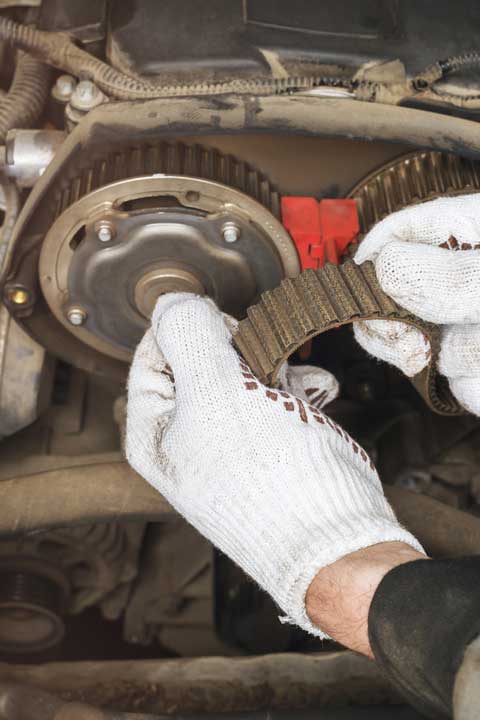
- An experienced mechanic can visually assess the condition of the timing belt and estimate its age.
If the previous owner of the car cannot document the last replacement and there is doubt about the age and condition of the timing belt, it may make sense to replace it just in case.
How can I check if the timing belt is bad?
The timing belt is usually hidden under a plastic cover, and it can be difficult to access properly without dismantling brackets, hoses and pipes beforehand. However, if you do get to it, there are several things you can look for.
Some signs that can be observed are:
- Cracks, wear or uneven surface of the belt.
- Discolorations or oil spills on the belt may indicate leakage from the engine.
- Frayed, torn or worn edges.
- Lots of slack or wear on the tensioner pulley that holds the belt in place.
- Unusual noises from the engine such as squealing, clunking or scraping, especially at start-up.
- Uneven or choppy engine running.
- Warning lights in the dashboard indicating engine failure.
Another sign that the timing belt may be bad is that other components at the front of the engine are leaking or worn. If coolant is leaking from the water pump or front seal, it is likely that the timing belt should also be replaced. Similarly, if the alternator, servo pump, or AC compressor show clear signs of wear.
If you have any doubts about the condition of the timing belt, it’s best to have it checked by a qualified auto repair shop. They can inspect it carefully and provide a concrete assessment of the remaining service life.
Is there a warranty on the timing belt?
Whether there is a warranty on the timing belt, and what the warranty covers, varies between manufacturers and auto repair shops. Warranties of 3-5 years or a certain number of kilometers are common. To be sure of what applies in your case, you should always check this in more detail with the auto repair shop that takes on the job of replacing the belt. An important prerequisite for the warranty is that the car’s service program is followed to the letter.
How do I know if it is a timing belt or timing chain?
Both the timing belt and timing chain perform the same task in the car engine, but there are some important differences:
- The timing belt is made of rubber with internal threads of Kevlar or other materials. The timing chain is made of metal with steel links.
- The timing belt runs on the outside of the motor and is visible if you remove the cylinder head. The timing chain runs inside the motor and is encapsulated.
- The timing belt is not lubricated and must be replaced at regular intervals, typically every 60-160.000 km. The timing chain is lubricated by the engine oil and is basically maintenance-free throughout the life of the engine.
You can check your car’s owner’s manual to see if it has a timing belt or chain. Alternatively, a mechanic can easily determine this by visually inspecting the engine. Please note that some car models may come with both a timing belt and a timing chain, depending on the engine variant and year model. You must therefore check the specifications for your car.
Can you change the timing belt yourself?
Replacing the timing belt yourself is not recommended, as it requires a lot of knowledge, tools and precision.
Good reasons to leave the replacement of timing belts to professionals:
- Access: To access the timing belt, you need to dismantle many components at the front of the engine, such as the water pump, dynamo bolts, cover plates and engine management. This requires special tools and lifting equipment many people don’t have at home.
- Tools: You’ll need access to a diverse range of tools to get the job done. This includes, for example, ratchet sets, extensions, latch arms, joint wrench sets, M10 internal dodecagon, support jacks, cam lock tools, etc.
- Risks: Small errors can lead to serious and costly consequences.
- Warranty: There is usually a warranty on work carried out by an auto repair shop.
- Time: Replacing a timing belt can take 3-8 hours even for an experienced mechanic
How do I get a quote for a timing belt replacement?
To get a quote for a timing belt replacement, you need to get in touch with an auto repair shop near you that offers this service. There can be many auto repair shops to choose from, depending on where you live in the country, and it can be difficult to know which one is best suited for the job. Auto repair shops may have different experience and expertise in replacing timing belts on different cars.
We want to save you time and make the process easier for you. We work with skilled auto repair shops across the country that have extensive experience with timing belt replacements and can put you in touch with a qualified repair shop in your area.
Fill in the form on our site with some information and we’ll forward your enquiry to the auto repair shop that best suits you and your car. Our service is free and non-binding. The auto repair shop in question will contact you shortly to make further arrangements.